|
|
Monday, 11:00 pm, 31 October 2005
Great Day for Corn Syrup We went to my wife's sister's for Halloween. I was in charge of handing out the ''candy'' to the costumed kids. One of the things my workmates would note in the UK was my stories of corn syrup. I don't remember talking about it at extraordinary lengths but I do think High Fructose Corn Syrup is a very dangerous and insidious sugar replacement. In 2000, when I lived in the US I found a mild allergy to corn syrup. It would produce attention deficit like symptoms and made traveling in cars very difficult. My vision would strobe and I felt generally out of sorts. My symptoms would last for up to two days from consumption based on volume. I searched on the internet for information about the negative effects of corn syrup. I found one article from the mid-1990s. Sometime between 1990 and 2000, US companies stopped using sugar in their products and converted almost exclusively to high fructose corn syrup. The primary reason was economics. Like the US tobacco growers' subsidies, US corn growers are subsidised to produce corn syrup and sugar is tariffed to make it artificially expensive in the US. My favourite hate site is the glamourous HFCS Facts. As with the tobacco industry in the US, all the user information comes from the producers of the product. The missing facts are by volume HFCS is less sweet than refined sugar. Sugar dissolves in liquid as opposed to corn syrup which itself takes substantial volume in contrast to a similar weight of sugar. The sweet of HFCS is not comparable to sugar. Refine sugar has a sharp sweetness whilst HFCS is a dull, almost waxy sweet. They are not the same product.
http://www.mercola.com/2002/jan/5/fructose.htm Thankfully there are now more sites that deal with the negative effects of HFCS. It begs the question, how did the US public allow sugar to be replaced in almost all their food-stuffs without any public scrutiny or discussion. How could this happen? That is the true fright of Halloween. Good night. Sunday, 09:40 pm, 30 October 2005 Since we moved to Las Vegas we have been plagued with the same recorded message, sometimes up to twice per day. Please call Miss Greentree now... Normally we just hang up, delete the message or generally shout down the phone. Since we subscribed to the do-not-call list, almost all other nuisance calls have stopped. But Miss Greentree will still call at least five times per week. Finally, Michele said to me a couple of days ago that I should call Greentree's 1-800 number and tell them to stop. I called the number; 1-800-414-4361 And I was told that it was an automatic message service and Miss Greentree's mailbox is full. How do we stop these frequent calls? I'm posting this to the Log with the blind hope that someone will Google Greentree and we can form a class-action delegation. (Legal information relating to Miss Greentree [01/06]) In other news... I recorded another Example Movie and put a front page on the directory; http://www.nobleape.com/examples/ I'm curious to see, following a release, if folks will watch the example movies and whether the general use patterns of the Simulation will change. It should be interesting. Good night. Friday, 10:00 pm, 28 October 2005 I went to the Meadows Mall today with my wife. iCon - Reductionist History I have been meaning to buy iCon for a number of months. Today I decided it was a must buy. Young and Simon's unauthorised biography of Steve Jobs features a couple of familiar characters in my own experience, Steve Wozniak, but perhaps more relevantly, John Draper. John is not mentioned by name in the book although his moniker Capt'n Crunch makes an entire paragraph early in the book. I've only read the first section of the book, I got it about three hours ago after all. But one thing strikes me. The section dealing with Draper is really poorly written and in fact the history of this time comes from two sources Jobs and Bill Fernandez (who lived opposite Wozniak, apparently). It is difficult to read another reductionist history of technology. It's nice that Wozniak is still mentioned. My prediction in the next twenty years is that Wozniak will eventually be removed through reduction from the popular history of Apple. Although names are ideally suited to reductionist history.
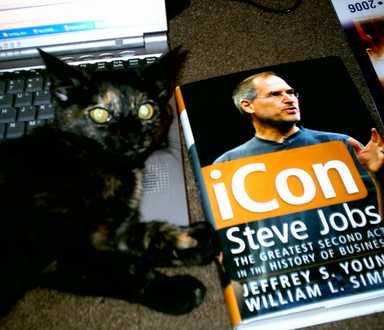 Luna is no fan of reductionist history either In contrast, I have been discussing with John Draper a set of interviews that expand his perspective of the history of companies like Apple and Autodesk, but also the smaller personalities in the history of technology. My friendly chats with Draper over the past decade have yielded a number of interesting personal insights that I would love to print in a forum like the Log. But it would be nice to hear them directly from Draper. The ratio of discussed projects to fruitful projects are remarkably low with Draper. But I'm keeping some energy in getting this project off the ground. US White Dwarf - A Better Product I have been buying US White Dwarf occasionally. Today I picked up the latest. My subscription and historical loyalty has been with the UK version of the publication. After all they misspelt my name on a number of occasions and produced a nice snap of my orcs - painted by Fred Reed. But this month's issue of White Dwarf in the US was a substantially better product than the UK version. More articles of interest including a variety of armies assembled from the starter boxes and some nice photos from Chicago Games Day. Although the quality of painted armies on eBay are still far superior in the UK. I stand corrected on the quality of US WD. In stark contrast, the UK product has dropped dramatically in the past four issues. They are now relying on the UK Web Team to publish the magazine. I'm a big of Owen R, having followed his rise through the Citadel Journal. But he is no Fat Bloke. The average age of WD UK dropped by ten years in the past four issues. The format is almost identical to the US production - they seem to be saving money by co-producing about eighty percent content. Noble Ape Posse I am planning on doing a swift release of 0.674 probably this Sunday with a version for Linux coming out very soon afterwards. A number of smaller bug fixes for folks who are already using ApeScript. I've started experimenting with video for assisting learning how to use the Simulation here's just over 9 Mb of Quicktime on how to edit variables of the Noble Ape Simulation; http://www.nobleape.com/examples/change_variables.mov Pedro asked for some information on the Simulation source. It begs the question, what information is best served in video form? Even assuming knowledge of coordinate systems might be too much information for the average Noble Ape user. It has produced a number of interesting thought experiments. I don't get a sense what the average user does with the Simulation. Friday WeFunk It's Friday. I got a nice email from Nick just before the show. Tonight's WeFunk show is playing in the background. An hour in, good laid back Friday night pace. The high paced shows seemed to work best for Saturday mornings in the UK. I miss those shows and regularly reflect with my iTunes playlist. I have a list of favourite shows I should put online. Good night. Wednesday, 10:30 am, 26 October 2005 The New York Times published the released emails to/from FEMA during Katrina. To save the information harvest you are required to do to read the New York Times, here are the two PDFs hosted locally;
20051022_FEMA1.pdf [785k] It looks like the documents from a law suit. Good morning. Tuesday, 02:00 pm, 25 October 2005 How embarrassing! I was working through some profiling on the Simulation on Mac last night when I noticed no Open Script menu item. The primary reason for the latest version. I rectified the situation this morning. http://mail.nobleape.com/pipermail/developer_nobleape.com/2005-October/000174.html When Ever Possible... In other news, I got an interesting email this afternoon. I suspect my dry continental philosophical answer may be lost on Texas high school students. But your never know. Howdy Steven,
Hello and good day! My institution is a public school in Texas, and one of our high schools has recently initiated something of a Socratic seminar-style forum where instructors can discuss topics they find interesting. I consider this topic, and the site in particular, to be quite interesting indeed.
Questions that come to mind: dangers of creating life that IS malicious...not all viruses and bacteria are beneficial to OUR life form, correct? What IS life? Should we amend the properties of accepted life to include mass as a defining quantity? Will we branch out into carbon and non-carbon-based life forms? As energy and mass are closely linked (you can't really have one without the other, after all), wouldn't a ANET-based life form have mass, even if it only consists of a few electrons "holding" the info together in cyberspace?
A number of interesting questions.
As an ALife/ANat developer, I take the meta perspective to a number of these questions. The philosophy is something that a user of ALife/ANat may toy with. But the developer is responsible for providing the breadth of tools to simulate/emulate/tackle these questions.
Take for example, natural language - if there weren't words to describe the diversity of possible conversation topics, they would not be discussed. So my sense is, in developing ALife/ANat software that you are providing the ''language'' for the discussion.
In terms of ''what is life?'', I have always reduced it to the most basic of philosophical answers. Life is an aesthetic quality. This removes life from questions of physics or chemistry and moves it into something of the Kantian sublime. It also acknowledges, quite neatly, that we have much to learn about life.
As an ALife/ANat developer, my only prerequisite is to try to provide tools in software that match the aesthetic quality of life. I don't need to worry about anything else. Similarly, I need to provide tools so folks can tinker to create their own interpretation of the aesthetic quality.
It might be a useful high school forum - what is the aesthetic quality of life?
Kant on the Sublime might be heavy going. But the general idea is complexity is inherent in nature. The smaller you look, the more detail you see.
Best regards,
Tom Barbalet.
I'm going to have to retract my view that folks who used Kantian examples in every day life were only interested in picking up chicks not making philosophical points. Perhaps my former view could be used to illustrate the benefits of Kant to Texas high school students.
Good afternoon.
[ Previous Log ]
| Barbalet's Log[ Log Archive ] |