|
|
Sunday, 11:00 pm, 06 November 2005
The Mariners of Homebrew I have been looking through and watching Bruce Damer's coverage of the Homebrew Computer Club's 30th Anniversary. I've not seen John Draper looking so happy - ever.
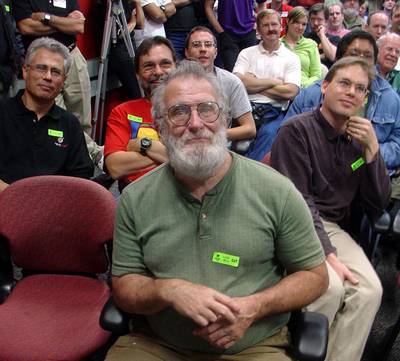 It reminds me of the merchant mariners and the Battle for the Atlantic. Whilst I was in the UK, it was announced that the 60th anniversary of the conclusion of the Battle for the Atlantic would be the last remembrance ever of this event. I think of the merchant mariners as some of the bravest civilians during the Second World War. Deciding to cancel any future remembrance seems to negate the need to remember such sacrifices. What will future generations know about the Homebrew Computer Club? Will it have any importance as the history of technology is progressively reduxed. There is no reason to believe that most of the folks involved with the Homebrew Computer Club won't live at least another thirty years. But will the story live on? I refer to my edition of the Computer Entrepreneurs by Levering, Katz and Moskowitz (circa 1984). What ever happened to Chuck Peddle, Jack Tramiel or William Godbout? There are tens of names in Levering et al. Of the names, the only ones that linger to this day are Gates, Bushnell. Hawkins and Jobs. The middle two are known through the games community. In Contrast... I spent my weekend reading a history of Rommel. My grandfather faced his folk in north Africa. I find the period between the First and the Second World War in German history a particularly fascinating time. I'm at that stage of the book currently. I also rewrote a combined simulation data structure for Noble Ape with the view that it would make birth a little easier to simulate. Including the combined data structure reduced the compilation size on the Mac by 5k! A huge improvement when the total application size is now 52k. Gotta love low-level C. Good night. Wednesday, 07:00 pm, 02 November 2005 I don't have time to write a log entry tonight. I picked up Age of Empires II Gold Edition. My favourite game of all time, now on our PC. Two emails on the developers' mailing list worth reading through; http://mail.nobleape.com/pipermail/developer_nobleape.com/2005-November/000182.html http://mail.nobleape.com/pipermail/developer_nobleape.com/2005-November/000183.html I'm honoured that someone of the calibre of Dr. Trebbin would be a fan of the Simulation. It makes the musing seem more worthwhile. Good night. Tuesday, 02:30 pm, 01 November 2005 I took Charlie for a long loop walk today. I took my digital camera to add some colour to the first log entry for this month.
 My man sets the pace...
A recurring theme in my life in terms of personal resolution is ''information as fact''. Very little of the information that is presented in the US is fact. The volume of information that is presented is opinion not fact. There is so much opinion that is presented as fact that one needs to regularly reflect on the qualities of facts versus the qualities of opinion. The distrust of facts comes through the confusion of fact with opinion. (HFCS Facts for example!) I think this is central to the conundrum relating to science versus religion (as an apparently coherent comparison) in the US. My narrative with regards to science versus religion is that they are clearly incompatible quantities. Religion is about belief. Very few people believe in science primarily because skeptical doubt is central to science. Fear of flying is a clear indicator that people don't believe in science. Religion is characterised by faith beliefs which transcend skeptical doubt. The problem is that science is frequently presented as opinion. Every few days the media reports on scientists evaluating the aesthetic beauty of playmates through the decades, the best vessels to drink beer from and more importantly constantly contradictory information about the detriment or benefits of eggs, red wine and vitamin pills. Science - popular science - requires funding and producing media reports is seen as being a good method for future funding. The enterprise of science brings into question whether science produces fact or opinion. But in many ways, this popular science undermines ''science as a discipline which is beyond science versus religion''. It in fact assists with portraying science as a laughable quantity. Noble Ape has never been (nor been funded like it was) popular science. Although Noble Ape has been discussed in popular science discussion forums and is listed as scientific on some download sites, my sense is that my loyalty lies with something that is very different to popular science. Something that perhaps comes from an idealised view of science. Science as a quantity that is totally incompatible with religion in terms of belief versus skepticism. I certainly feel impassioned when people talk about artificial life fitting coherently in the science versus religion discussion. I'd like to think that children in the US states that support religion being taught as science would use Noble Ape independently. If the folks on the science ''side'' who fuel the debate had any strategic perspective they would demand that science was also adopted in religious studies classes. To identify coherently that if people find science and religion to be compatible quantities they need to give some time to science as a belief. Good afternoon. [ Previous Log ]
| Barbalet's Log[ Log Archive ] |